Warren County Home Prices Are Still Rising — Just Not the Way They Used To
.png?w=128&h=128)
Leigh Ann Parkinson
No pressure, no pretense, and no recycled advice — whether you're selling, buying, or figuring out which comes first...
No pressure, no pretense, and no recycled advice — whether you're selling, buying, or figuring out which comes first...
Through July 2026, single-family home prices in Bowling Green and Warren County, KY are up about 1% year over year — a median of $318,000, compared with $314,950 in 2025. Homes are selling for roughly 98% of their asking price and taking about 70 days to sell. The market is still growing, just at a calmer pace than the past few years, when prices were climbing closer to 5% annually.
The market is still growing — it just downshifted
Sometimes the market feels different. National headlines and watching a neighbor's house sit for months can suggest something that doesn't match the reality. As a long-time appraiser, I believe in looking at what the numbers actually say — here in Bowling Green. If you're thinking about a move or just want to be informed, keep reading.
Two things I can compare cleanly to last year, apples to apples:
Homes sold, January through July: 827 this year, up from 792 in the same stretch of 2025. That's about 4% more closings. The market's still busy.
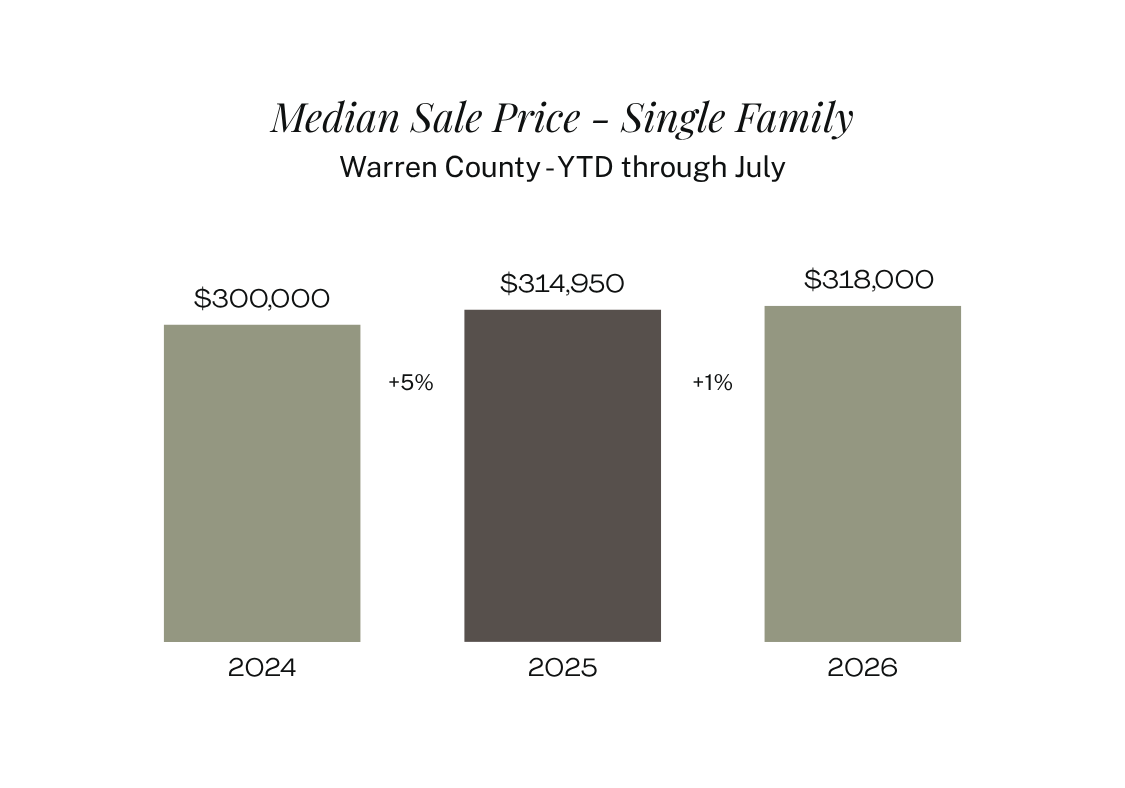
Median sale price, January through July: $318,000 this year versus $314,950 last year — up about 1%.
Here's the part worth pausing on. Last year, that same January-through-July median jumped roughly 5% (from $300,000 in 2024 to $314,950 in 2025). This year it's up about 1%. So prices are still climbing, just at a gentle stroll instead of a sprint. If you've been waiting on a price "crash," this isn't that. It's more like the market caught its breath.
.png)
July itself was quieter — but Spring was not
July closings came in at 112, down from 134 last July. One month on its own always makes me want to add context, so here it is: April, May, and June this year were the three strongest months we've seen in at least three years. When a spring runs that hot, some closings that might've landed in July tend to get pulled into June instead. I'd call July a breather, not a turn.
Homes are still selling close to asking — but pricing is pulling more weight
The typical home sold for about 98% of its asking price in July. That's strong. It means buyers and sellers are landing in roughly the same ballpark on value.
But here's the nuance most reports skip: getting to that number is taking a little more finesse than it used to.
About 1 in 3 homes that sold in July had lowered their price at least once before finding a buyer (39 of 112).
More than half the homes currently on the market have trimmed their price at some point (264 of 489).
Read that the right way. A price reduction isn't a distress signal — it's a course correction. Plenty of those sellers started a hair high, adjusted to what buyers were telling them, and still closed near their asking price. The homes that price it right from day one? They tend to skip the whole dance.
Typical time to sell ran about 70 days (that's the median — half sold faster, half slower). So if your neighbor's house takes a couple of months, that's normal, not a red flag. Over 90 days on the market likely means that price, condition or marketing aren't motivating buyers.
Every ZIP — and every street — is its own market
Countywide numbers are great for the big picture, but they blend a $250,000 starter home and a $600,000 custom build into a single figure. Here's how July looked by ZIP:
42101: median around $266,750 (this was the busiest area, so it's the most reliable read)
42104: median around $330,500
42103 and 42122: the higher end of the county, both landing north of $500,000 in July — though on only a handful of sales each, so treat those as directional, not gospel.
The takeaway isn't the exact dollar figure. It's that where you are, and what you own, matters far more than any countywide average. Your street, your price range, and your home's condition each have their own story.
If you're selling in 2026
- Price it to today's market from day one. The homes selling near asking are the ones that read the room early. Starting high to "test it" is exactly what kicks off the reduction cycle and forces you to chase the market downward.
- Your home's first showing happens online. Buyers fall for a home — or scroll right past it — on a screen long before they ever pull into the driveway. Sharp photography, video, and a well-marketed listing are what turn a scroll into a real showing. Skimp on the visuals and you're quietly losing buyers you'll never even know were interested.
- Expect a real timeline. Around two months to sell is typical right now. That's not slow — that's the market.
If you're buying in 2026
You've got a real selection. There are just under 500 single-family homes on the market across the county right now. Take your time finding the right one. As activity slows going into fall and winter, there will be some great values on properties that were overpriced initially, if history repeats itself.
Lowballing mostly won't fly. But a home that's already reduced or been sitting a while may have genuine room — knowing which is which is the whole game.
Line up your financing first, so when the right house shows up, you're ready to move instead of scrambling.
One thing to remember: the marketwide average does not tell you how long any particular home will be available. If you love a home that is in great condition, supported by strong marketing, and competitively priced, it may move much faster than the average suggests.
.png)
The one thing this report can't tell you
Whether it's a good time for you to make a move. A countywide median can't see your specific street, your home's finishes, your ZIP's price tier, or what comparable homes near you are actually doing. That's the analysis that matters — and it happens to be the one I love doing.
If you're weighing a move this year, let's talk about your numbers, not the county's. I'll pull the real picture for your home or your target neighborhood — no pressure, no sales pitch, just straight data and a plan.
Questions?
.png?w=380&h=254)